MYKOYNS
Philippine Numismatics
USPI BANKNOTES
U.S.-Philippine BANKNOTES (1903–1944)
Banknotes have long played an important role in commerce, particularly in facilitating larger transactions. In the Philippines, paper currency first appeared during the Spanish colonial period and was primarily issued by private banks—most notably Banco Español Filipino.
Following the Philippine Coinage Act of 1903, the United States not only introduced a new coinage system for the Philippines but also issued government-backed banknotes known as silver certificates.

U.S.–Philippine banknotes issued between 1903 and 1944 represent an important chapter in the development of the Philippine monetary system. These notes served as both instruments of exchange and symbols of the political and cultural landscape of the era, featuring a blend of American leaders, Filipino figures, and historical landmarks.
Today, these notes are widely studied by collectors of U.S.–Philippine banknotes, Philippine paper money, and American colonial currency.
On This Page
Government Issue Banknotes
Following the Philippine Coinage Act of 1903, the United States government introduced official banknotes for circulation in the Philippines. These notes were issued directly by the colonial administration and formed the backbone of the country’s paper currency system during the American period.
The principal government-issued notes included silver certificates and later treasury certificates, both of which circulated widely throughout the archipelago. These banknotes were designed to support the new monetary system established under U.S. rule and were backed either by silver reserves or by the credit of the Philippine Treasury.
Historical Significance
U.S.–Philippine banknotes (1903–1944) represent a key stage in the development of the Philippine monetary system under American rule. Introduced alongside a new coinage system, these notes supported commerce while reflecting the political and cultural environment of the period through their designs, inscriptions, and issuing authorities.
Silver Certificates (1903–1918)
Silver certificates were paper notes backed by silver reserves held by the Treasury. Although they circulated like ordinary banknotes, they represented a claim on a fixed amount of silver.
Typically inscribed on these notes was the phrase: "Payable to the bearer on demand in silver pesos or gold coin"
This meant that the holder could redeem the note for a fixed amount of silver or gold. This convertibility gave the certificates tangible value and earned public trust.
Notably, the notes referred to the country as the Philippine Islands, reflecting its official designation as a U.S. territory during that period.
Denominations and Designs
-
₱2 – José Rizal
-
₱5 – William McKinley
-
₱10 – George Washington
-
₱20 – Mount Mayon (Albay)
-
₱50 – General Henry Lawton
-
₱100 – Ferdinand Magellan
-
₱500 – Miguel López de Legazpi
Issuance Timeline
-
1903 – First issuance of the ₱2, ₱5, and ₱10 notes—the seal shows a woman holding a hammer, similar to the obverse of the USPI silver coins.
-
1905 – Introduction of the ₱20, ₱50, ₱100, and ₱500 notes—beginning with this series, the seal was changed.
-
1906 – New issue of the ₱2 and ₱500 notes
-
1908 – New issue of the ₱20 note only
-
1910 – New issue of the ₱5 note only
-
1912 – New issue of the ₱10 note only
-
1916 – Final issues of the ₱50 and ₱100 notes


1903 2P and 5P, Images Source: Standard Catalog of World Paper Money (2017 Edit 16)
Treasury Certificates (1918–1941)
In 1918, the U.S. government replaced silver certificates with treasury certificates in the Philippines. Unlike their predecessors, these were not backed by silver, but by the general credit of the Treasury.
The shift was likely influenced by fluctuations in global silver prices and the practical challenges of maintaining large silver reserves. Despite the shift, the notes retained the familiar inscription:
"Payable to the bearer on demand in silver pesos or gold coin"
This phrase was likely retained to maintain public confidence and visual continuity.
These certificates retained the same denominations and portrait designs as the earlier silver series, with one major addition:
-
₱1 – Apolinario Mabini
Issuance Timeline
-
1918 – First issuance of ₱1, ₱2, ₱5, ₱10, ₱20, ₱50, ₱100, and ₱500
-
1924 – New issue of ₱1, ₱2, ₱5, ₱10, and ₱500 notes, now printed without underprints
-
1929 – Final pre-Commonwealth issue of all denominations
-
1936 – First Commonwealth treasury certificate series: ₱1, ₱2, ₱5, ₱10, ₱20, ₱50, ₱100, and ₱500
-
1941 – New issue of ₱1–₱20 notes; higher denominations were not shipped due to World War II
-
1944 – Victory Series No. 66 issued, consisting of ₱1, ₱2, ₱5, ₱10, ₱20, ₱50, ₱100, and ₱500 featuring “VICTORY” boldly printed on the reverse to symbolize liberation and renewed sovereignty.


1929 1P and 10P and, Images Source: Standard Catalog of World Paper Money (2017 Edit 16)
Private and Institutional Issues
Alongside government-issued banknotes, several financial institutions in the Philippines were authorized to issue their own paper currency during the American colonial period. These notes were typically backed by the issuing bank and circulated alongside official government currency.
Among the most notable issuers were Banco Español Filipino—later renamed the Bank of the Philippine Islands (BPI)—and the government-owned Philippine National Bank (PNB). Their banknotes played an important role in supporting commerce and banking operations during the early decades of the 20th century.
Historical Significance
Private issue banknotes supported commerce alongside government currency during the American period, reflecting the role of early Philippine banking institutions in the evolving monetary system.
Banco Español Filipino and the Bank of the Philippine Islands (1904–1933)
During the American period, the Banco Español Filipino retained its charter to issue banknotes. In 1904, it reissued its earlier Spanish-period notes—₱5, ₱10, ₱25, ₱50, ₱100, and ₱200. A distinctive feature of this reissue was the omission of the word fuertes, previously used to denote the currency's legal strength.
In 1908, a new series was introduced, now printed in the United States and featuring classical female figures in the design—an artistic shift influenced by Western neoclassical trends.
By 1912, the bank had officially changed its name to Bank of the Philippine Islands (BPI). The notes issued that year reflected this transition, along with the translation of Spanish to English text.
Subsequent Reissues
-
1920 and 1928 – Issues with updated dates and minor design tweaks
-
1933 – Final issue, limited to ₱5, ₱10, and ₱20 denominations


1904 100P and 200P , Images Source: Standard Catalog of World Paper Money (2017 Edit 16)
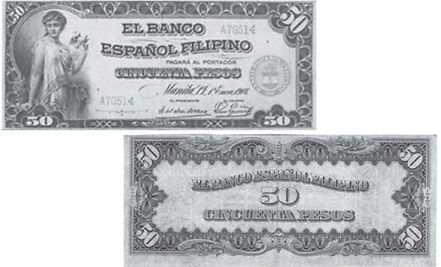

50P 1908 issue vs 1912, Images Source: Standard Catalog of World Paper Money (2017 Edit 16)
Philippine National Bank (PNB) (1916–1944)
The Philippine National Bank (PNB) was established in 1916 as a state-owned bank, created to serve as the national depository and provide financial services for the developing nation.
This series followed the general design style of the silver certificates but introduced new portraits for two denominations:
-
₱1 – Charles A. Conant
-
₱20 – William A. Jones
A notable feature on PNB notes is the phrase: "In lawful currency of the Philippine Islands"
Emphasizing their legal tender status under U.S. colonial rule.
Issuance Timeline
-
1916–1920 – First issuance of ₱1, ₱2, ₱5, ₱10, ₱20, ₱50, ₱100, and ₱500
-
1921 – New issue of ₱1, ₱2, ₱5, ₱10, and ₱20 without underprints
-
1924 – New issue of the ₱1 note only
-
1937 – Final issue of ₱5, ₱10, and ₱20 notes
Emergency Circulation Notes
-
1917 – During World War I, PNB issued emergency 10, 20, and 50 centavo notes to address currency shortages
-
1919 – A second emergency series was created by defacing BPI banknotes and overprinting them with “The Philippine National Bank” on the reverse.

20C Emergency Banknotes, Images Source: Standard Catalog of World Paper Money (2017 Edit 16)

1919 5C Defaced Emergency Banknotes, Images Source: Standard Catalog of World Paper Money (2017 Edit 16)


1916-1920 1P and 20P Regular Issue, Images Source: Standard Catalog of World Paper Money (2017 Edit 16)
Scarcity and Collectibility
As with United States–Philippine (USPI) coins, many of these historical banknotes were naturally lost, damaged, or worn down over time. Their fragile nature—especially without proper care and storage—made them more susceptible to deterioration than coins.
The chaos of World War II further contributed to their destruction and scarcity. Surviving examples—particularly those in higher grades—are increasingly scarce today and often command strong premiums in the collector market.
Collector Quick Reference
Type: Banknotes
Issuance Period: 1903–1946
Major Issuers and Common Denominations
-
Silver Certificates (1903–1918): ₱2, ₱5, ₱10, ₱20, ₱50, ₱100, ₱500
-
Treasury Certificates (1918–1941): ₱1, ₱2, ₱5, ₱10, ₱20, ₱50, ₱100, ₱500
-
Banco Español Filipino / Bank of the Philippine Islands (1904–1933): ₱5, ₱10, ₱25, ₱50, ₱100, ₱200
-
Philippine National Bank (1916–1944): ₱1, ₱2, ₱5, ₱10, ₱20, ₱50, ₱100, ₱500
Key Design Elements
-
Portraits of historical figures and political leaders
-
Vignettes of Philippine landmarks and allegorical scenes
-
Official government and institutional seals
Notable Collectible Features
-
Defaced BPI banknotes overprinted by the Philippine National Bank (1919 emergency issues)
-
Victory overprint on the 1944 Victory Series treasury certificates
-
Central Bank overprints applied to surviving pre-war notes after liberation
Summary
-
U.S.–Philippine banknotes (1903–1944) formed a key part of the monetary system under American rule
-
Included both government-issued notes and private/institutional banknotes
-
Main government issues: Silver Certificates (1903–1918) and Treasury Certificates (1918–1941)
-
Private issuers included Banco Español Filipino/BPI and Philippine National Bank (PNB)
-
Designs featured historical figures, landmarks, and official seals
-
Notes reflected political changes, including the Commonwealth period and World War II
-
Special issues included emergency notes, overprints, and the 1944 Victory Series
-
Many notes are scarce today due to wear, loss, and wartime destruction
References & Sources:
Bangko Sentral ng Pilipinas – "History of Philippine Money."
Ocampo, Ambeth R. "Yaman: History and Heritage in Philippine Money." Manila: Bangko Sentral ng Pilipinas, 2020.
Selected numismatic articles, auction archives, and collector references used for comparative study.
Continue Exploring Philippine Currency Timeline:
-
Back to: U.S. Colonial Currency in the Philippines (1903-1946)
-
Previous: U.S.-Philippine Coinage (1903-1946)
-
View the Philippine Currency Timeline
Published Date: 7/6/2025
Last Updated: 3/8/2026