MYKOYNS
Philippine Numismatics
MACHINE-STRUCK COINAGE
Spanish Milled Coinage
in the Philippines (1732-1825)
Spanish Milled Coinage in the Philippines refers to machine-struck silver and gold coins produced in Spanish colonial mints beginning in the early 18th century and circulated throughout the Spanish Empire. Introduced to replace the irregular hand-struck cob coinage, these coins offered more consistent weight, shape, and design and became an important part of Philippine and Asian commerce.
On This Page
Role in Philippine Currency History
Spanish milled coins entered the Philippines through the Manila–Acapulco Galleon Trade and became an important medium of exchange in both local and international commerce. Their reliable bullion content allowed them to circulate widely across Asia, where they were valued not only as currency but also as trusted silver and gold for trade.
Manila’s position as a major trading hub linked Spanish America with China, Southeast Asia, and other parts of the Pacific. Silver and gold coins transported aboard the galleons were exchanged for Asian goods such as silk, porcelain, spices, and textiles. Because merchants, especially Chinese traders, valued bullion content, Spanish milled coins became a preferred medium of exchange in regional commerce.
Historical Significance
Spanish milled coinage marks a major turning point in colonial money. It brought a higher level of standardization to the silver and gold coinage that circulated in the Philippines and helped strengthen Manila’s role as a trading center in Asia.
Origins and Spanish Milled Coinage
By the early 18th century, the limitations of cob coinage had become increasingly apparent. Hand-struck coins often varied in weight and shape, making them susceptible to clipping and counterfeiting. To address these issues, the Spanish Crown introduced mechanized minting technology in its colonial mints beginning in 1732.
These new coins were produced using screw presses and rolling mills, which allowed for greater consistency in weight, diameter, and design. The result was a more reliable and visually refined coinage that gradually replaced cob coinage throughout much of the Spanish Empire, although cob production continued until 1773.
Major colonial mints responsible for producing milled coinage included Mexico City, Lima, Potosí, and Guatemala. From these mints, large quantities of coins were shipped to Manila through the galleon trade, where they circulated extensively in the Philippine economy.
The Pillar Dollar Series (1732–1772)
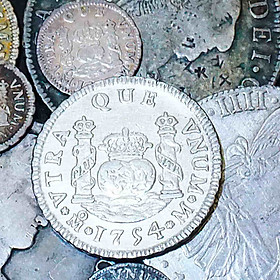
The earliest Spanish milled coins are commonly known as Pillar Dollars or Columnarios. This series introduced a new design centered on the Pillars of Hercules and the symbolic union of the Old and New Worlds. The imagery emphasized the unity of Spain’s trans-Atlantic empire and helped distinguish the new mechanized coinage from earlier hand-struck issues.
The pillar dollar quickly gained international recognition because of its reliable silver content and consistent weight. In many parts of Asia, including the Philippines, these coins became trusted trade currency and were widely accepted in regional commerce.

1754 2 Reales Milled Coin
The Portrait Series (1772–1821)
Beginning in 1772, Spanish milled coinage underwent a major design change. The earlier pillar design was replaced with portrait coinage featuring the bust of the reigning Spanish monarch. While the design changed, the coins retained their role in trade and continued circulating widely in international commerce.
In the Philippines, portrait dollars remained a common form of currency during the late Spanish colonial period. The reform marked a clear visual transition within Spanish milled coinage while maintaining the broader function of these coins in trade and circulation.

1794 8 Reales Milled Coin
Denominations and Standards
Spanish milled coinage followed the real and escudo monetary system used throughout the Spanish Empire. Silver coins circulated in denominations from ½ real to 8 reales, while gold escudos were minted for higher-value use.
Among these denominations, the 8 reales coin, commonly known as the Spanish dollar, became one of the most influential trade coins in world history. Because of its consistent weight and high silver purity, it gained widespread trust across Europe, the Americas, and Asia. Merchants often valued it by its silver content rather than by official face value.
The Spanish Dollar as a Global Trade Currency
Through the Manila–Acapulco Galleon Trade, large quantities of Spanish silver dollars were transported from colonial mints in the Americas to Manila, where they were exchanged for Asian goods. Manila’s role as a major trading hub helped ensure that Spanish colonial coins circulated widely throughout the Philippines and across Asian trade networks.
Chinese merchants in Manila and other trading centers accepted these coins because of their reliable silver content, which made them suitable for melting, weighing, or further circulation in regional markets. As a result, the Spanish dollar became a dominant currency in international trade during the 18th and early 19th centuries and later influenced other currencies, including the United States dollar.
Transition to Later Colonial Coinage
By the early 19th century, the steady supply of Spanish colonial coinage reaching the Philippines began to decline. Political upheavals and independence movements throughout Spanish America disrupted the colonial minting system that had long supplied coins to Manila.
The end of the Manila–Acapulco Galleon Trade in 1815 further reduced the inflow of coins into the Philippines. As Spain gradually lost control of many of its American territories, the supply of freshly minted coins from major colonial mints became increasingly irregular. By the 1820s, this disruption had created significant monetary challenges in the Philippines.
When Bolivia declared independence in 1825, the traditional supply network of Spanish imperial coinage from Latin America was effectively disrupted. To address the resulting shortage of circulating currency and manage the influx of republican coins from former Spanish colonies, authorities introduced counterstamping. These counterstamped coins later became an important transitional stage between earlier Spanish colonial coinage and later monetary reforms in the Philippines.
Collector Quick Reference
-
Coin Type: Milled
-
Minting Period: 1732–1825
-
Primary Metal: Silver and gold
-
Common Denominations: ½, 1, 2, 4, and 8 Reales
-
Major Mints: Mexico City, Lima, Potosí, and other Spanish colonial mints
-
Importance to Philippine Numismatics: Standardized trade coinage widely used in the Philippines through the galleon trade
For a deeper look, continue to the Milled Coinage Collector Guide.
Summary
-
Spanish milled coinage replaced irregular cob coinage with machine-struck silver and gold coins beginning in 1732.
-
These coins reached the Philippines through the Manila–Acapulco Galleon Trade and became central to both local and regional commerce.
-
The series developed from the Pillar Dollar type to the Portrait series while continuing to serve as trusted trade coinage.
-
The 8 reales Spanish dollar became a major global trade currency because of its reliable silver content and consistent weight.
-
Supply disruptions in the early 19th century helped lead to counterstamped coinage as a transitional stage in Philippine monetary history.
References & Sources:
Bangko Sentral ng Pilipinas – "History of Philippine Money."
Ocampo, Ambeth R. "Yaman: History and Heritage in Philippine Money." Manila: Bangko Sentral ng Pilipinas, 2020.
University of Notre Dame. "Spanish Coinage Circulating in the Colonies"
Larreal, Hussein. "How the 8 Reales Became a World Currency." CoinsWeekly.
Wikipedia Contributors. "Spanish Dollar." Wikipedia.
Wikipedia Contributors. "Milled Coinage." Wikipedia.
Selected numismatic articles, auction archives, and collector references used for comparative study.
Continue Exploring Philippine Currency Timeline:
-
Back to Spanish Colonial Currency in the Philippines (1565–1898)
-
Previous: Spanish Cobs Coinage in the Philippines (1572–1773)
-
View the Philippine Currency Timeline
Published Date: 2/03/2025
Last Updated: 3/4/2026