MYKOYNS
Philippine Numismatics
Spanish-Philippine Copper Coinage (1728–1835)

Spanish-Philippine Copper Coinage refers to small-denomination coins that circulated in the Philippines primarily during the eighteenth and early nineteenth centuries. These small-denomination coins were produced locally to support everyday transactions within the colony. While silver coins such as reales and pesos dominated long-distance trade and government payments, smaller copper coins were necessary to support local commerce in markets and communities across the archipelago.
Unlike most colonial coinage circulating in the Philippines, which originated from Spanish mints in the Americas such as Mexico City, Lima, and Potosí, many early copper coins were produced locally to address the persistent shortage of small change needed for daily commerce.
The circulation of copper coinage reflects the evolving monetary system of the Spanish colonial Philippines, where imported silver currency used for regional and international trade existed alongside locally circulating copper coins that supported everyday economic activity.
Quick Collectors Reference:
Coin Type: Copper
Minting Period: 1728-mid-19th century
Primary Metal: Copper
Common Denominations: Barilla, Quarto, Octavo
Major Mints: Commissioned by the colonial government and produced by local private contractors in Manila.
Key Design Elements
-
Barilla
-
Inscription “Ciudad de Manila” (City of Manila)
-
Early issues often feature a prominent letter “B”, indicating the denomination
-
-
Octavo and Cuarto
-
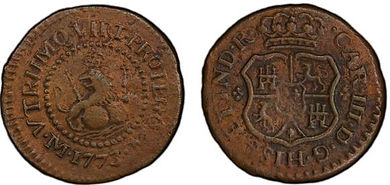
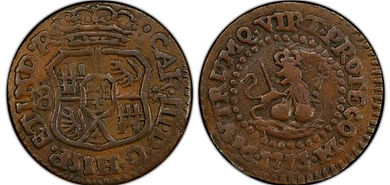
Inscription “VTRUMQ VIRT PROTEGO” (Latin: I protect both virtues)
-
Manila sea lion wielding a sword standing above two globes
-
Stars flanking the shield on later issues (introduced around 1798)
-
Typical Sizes
-
Octavo: ~18 mm
-
Cuarto: ~22 mm
-
-
Notable Collectible Features
-
Early Barilla copper coinage, among the first locally produced coins in the Philippines
-
Numerous die varieties and minor design variations
-
Wide differences in weight, strike quality, and fabric due to private contract production
Monetary Conditions in the Colony
During much of the Spanish colonial period, the Philippines relied heavily on silver coinage imported from Spanish America. The colony was administratively under the Viceroyalty of New Spain (Mexico), and the authority to mint official coinage for the empire generally rested with established royal mints in the Americas.
As a result, the Philippines lacked a permanent mint for most of the colonial period. Silver coinage—particularly Spanish reales and pesos—arrived through trade networks such as the Manila–Acapulco Galleon Trade (1565–1815) and became the dominant form of currency circulating in the archipelago.
However, these silver coins were often too large in value for everyday transactions, creating a persistent shortage of small denominations needed in markets and local commerce.
Early Local Copper Coinage and the Barilla
To address the lack of small change, locally produced copper coins began circulating in the Philippines. Although the earliest surviving barilla coins are dated to around 1728, historical research suggests that locally minted copper coinage may have existed as early as the seventeenth century.
These early copper coins—commonly referred to as barillas—were produced locally to facilitate small-scale trade. Because the Philippines was under the jurisdiction of Mexico and lacked royal authorization to mint its own official coinage, these early issues were not formally recognized by the Spanish Crown.
Instead, the coins were tolerated as a practical solution to the colony’s monetary shortage and were permitted to circulate primarily within local communities.
Barillas generally featured simple markings or letters rather than elaborate royal designs, reflecting their unofficial and utilitarian nature. Their limited oversight also made them vulnerable to counterfeiting, which became a recurring problem for colonial authorities.
Despite these limitations, the barilla represents one of the earliest known forms of locally produced coinage in the Philippines and played an important role in facilitating everyday commerce.
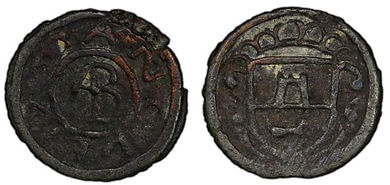
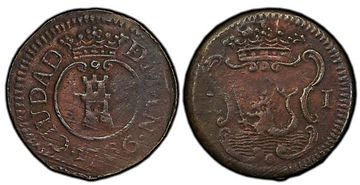
The name barilla is believed to originate from the Spanish word barra, meaning a bar or rod of metal. In colonial usage, the term came to refer to small copper pieces used as low-value currency. In the Philippines, these locally produced copper coins became known as barillas, a name that was later adapted into local language and eventually evolved into the modern Filipino word barya, which today refers to small coins or loose change.
Royal Authorization and the Introduction of the Quarto
Eventually, the Spanish Crown recognized the need for officially sanctioned copper coinage in the Philippines. When authorization was granted to produce local copper coins in 1766, a new denomination known as the quarto was introduced, and minting started in 1771. Unlike earlier barillas, quarto coins carried the coat of arms of Spain, signaling official recognition and royal authority. These coins represented a more formal attempt to regulate the colony’s small-denomination currency.
With the introduction of officially sanctioned copper coins, earlier barillas were gradually recalled from circulation. The quarto became an important component of the colonial monetary system, providing a regulated form of fractional currency that could circulate alongside the silver coinage imported from Spanish America.
Historical records also indicate that the local value relationship between copper coins and silver reales sometimes differed from official Spanish standards, reflecting the unique economic conditions of the Philippine colony.

Denominations and Relative Value
The copper coinage circulating in the Philippines during the Spanish colonial period included several small denominations intended to facilitate everyday market transactions. Among the most commonly referenced types were the barilla, cuarto, and octavo, each representing small fractional values within the colonial monetary system.
The earliest locally produced copper coins were known as barillas. Because these coins were issued locally and lacked formal authorization from the Spanish Crown, they did not have a fixed exchange rate within the official imperial monetary system. Instead, their value was largely determined by local usage and market practice. Historical interpretations suggest that several barillas may have circulated roughly equivalent to a single cuarto or 1 centavo, though the precise relationship likely varied depending on local economic conditions and the availability of silver currency.
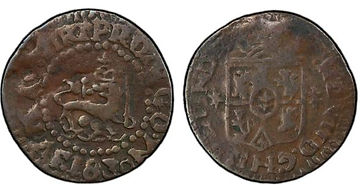
When the Spanish Crown eventually authorized the production of official copper coinage for the Philippines, new coins known as cuartos were introduced. These coins were issued in denominations of one cuarto and one-half cuarto, the latter commonly referred to as an octavo. Unlike the earlier barillas, these coins carried the royal coat of arms of Spain, indicating their official status.
Historical research suggests that colonial authorities established a local exchange value of seventeen cuartos to one silver real, a valuation that differed from the traditional Spanish imperial standard of twenty cuartos per real. According to some numismatic accounts, the copper denominations were structured so that eight octavos equaled four cuartos per real. This adjustment reflected the unique economic conditions of the Philippine colony and was intended to encourage the circulation of the newly introduced copper coinage.
Philippine Colonial Circulation Practice:
Unit Relationship
Octavo ½ cuarto
Cuarto base copper coin
Real 4 cuartos / 17 cuartos / 20 cuartos
Peso 8 reales
Together, these copper denominations formed an important component of the colonial monetary system, providing the small units of currency necessary for everyday transactions within markets and local communities.
Design Characteristics
While Spanish colonial coins generally followed the design traditions established throughout the Empire—typically featuring royal symbols that asserted Spanish authority and sovereignty—the barrillas remained a notable exception. These crude, locally-struck coins often bore the seal of the Cabildo of Manila rather than the imperial coat of arms.
Common design elements include heraldic symbols of the Spanish crown, which are frequently featured on both cob and milled coinage. Unlike many later colonial coinages, Spanish-Philippine copper coins often did not display explicit denomination markings. Their values were typically distinguished by size, weight, and recognizable design types. In some cases, identifying marks such as the letter “B” appeared on certain barrilla issues, while other copper coins shared similar designs and were differentiated primarily by their physical dimensions.
Circulation and Use
Spanish-Philippine copper coins circulated mainly in local markets where they facilitated small everyday transactions such as food purchases, household goods, and minor services.
Because of their relatively low intrinsic value and simple design, copper coins were particularly susceptible to counterfeiting and unofficial reproduction, posing a persistent challenge for colonial authorities attempting to regulate the currency supply.
Due to their small size and frequent circulation, surviving examples of these coins are often heavily worn, reflecting their extensive use in everyday transactions.
Silver Fractional Coinage: The Quartillo
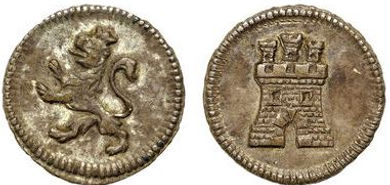
In addition to copper coins, small fractional silver coins also circulated in the Philippines. One example is the quartillo, a silver coin valued at ¼ real. To address the need for smaller silver denominations in the colony, Philippine colonial authorities requested that these coins be minted at the Mexico City Mint during the mid-18th century. Numismatic sources indicate that the first recorded mintage occurred in 1770.
The design of the quartillo was relatively simple, typically featuring a lion on the obverse and a castle on the reverse, representing the heraldic symbols of the Spanish kingdoms of León and Castile.
Although the quartillo was not part of the locally issued copper coinage system, it served a similar purpose by providing a small unit of silver currency suitable for everyday transactions. In practice, these fractional silver coins circulated alongside copper denominations such as the barilla, octavo, and quarto, contributing to the diverse mixture of currencies used within the colonial Philippine economy.
End of Local Copper Coinage and the Introduction of Spanish Cuartos
By the mid-1830s, Spanish authorities began implementing broader monetary reforms that would significantly alter the circulation of copper coinage in the Philippines. Although locally issued copper coins such as the quarto had circulated for decades, colonial administrators sought to bring the Philippine monetary system more closely in line with that of Spain.
In 1836, the Spanish treasury (Hacienda) issued a decree ordering the importation of copper cuartos minted in Spain for widespread circulation in the Philippines.
The first shipment of these peninsular coins arrived in the colony in 1837, marking an important shift in the monetary system. With the introduction of these imported coins, the long period of locally produced colonial copper coinage gradually came to an end.
This transition marked the gradual replacement of locally issued copper coinage with imported Spanish currency and formed part of the broader monetary reforms that eventually culminated in the introduction of Spanish-Philippine Decimal Coinage in 1861.
References & Sources:
Boncan, Celestina P. The Copper Coinage of the Cabildo of Manila. Philippine Studies, Vol. 33, No. 4 (1985).
Boncan, Celestina P. Colonial Copper Coinage in the Tobacco Monopoly, 1769–1837. Philippine Studies, Vol. 34, No. 4 (1986).
Bangko Sentral ng Pilipinas – History of Philippine Money
Ocampo, Ambeth R. Yaman: History and Heritage in Philippine Money. Manila: Bangko Sentral ng Pilipinas, 2020.
Basso, Aldo P. Coins, Medals and Tokens of the Philippines. Menlo Park, CA: Chenby Publishers, 1968.
Selected numismatic articles, auction archives, and collector references used for comparative study.
Continue Exploring Philippine Currency Timeline:
-
Back to Spanish Colonial Currency in the Philippines (1565–1897)
-
Previous: Spanish Milled Coinage in the Philippines (1732–1825)
-
Next: Counterstamped and Countermarked Coins in the Philippines (1828–1839)
-
View the Philippine Currency Timeline
Published Date: 2/24/2025
Last Updated: 3/7/2026