Japanese Invasion Money and Occupation Medals

WARTIME CURRENCY & MEDAL
Home / Philippine Numismatics Collectors Hub / Currency Collecting / Japanese Invasion Money and Occupation Medals

Exploring Japanese Invasion Money (JIM) in the Philippines and the commemorative medals of the occupation period reveals a distinct area of numismatics shaped by wartime conditions, reflecting how currency and medals were produced, used, and preserved during one of the most complex periods in Philippine monetary history.
For a broader historical context of how these issues fit within the country’s monetary evolution, see Japanese Occupation Currency in the Philippines (1941-1945).
Quick Reference
Type: Banknote & Medal
Issuing Period: 1941-1945
Denominations
1942 First Issue: 1 Centavo, 5 Centavos, 10 Centavos, 50 Centavos, 1 Peso, 5 Pesos, 10 Pesos
1943-1945 Second Issue: 1 Peso, 5 Pesos, 10 Pesos, 100 Pesos, 500 Pesos, 1000 Pesos
Collectible Medal Summary: Surviving occupation medals are known in silver and bronze issues.
Collecting Focus
Block letter varieties
Numerical serial issues
Allied counterfeits
Propaganda overprints
Known medal types and inscriptions
Identification Features of JIM
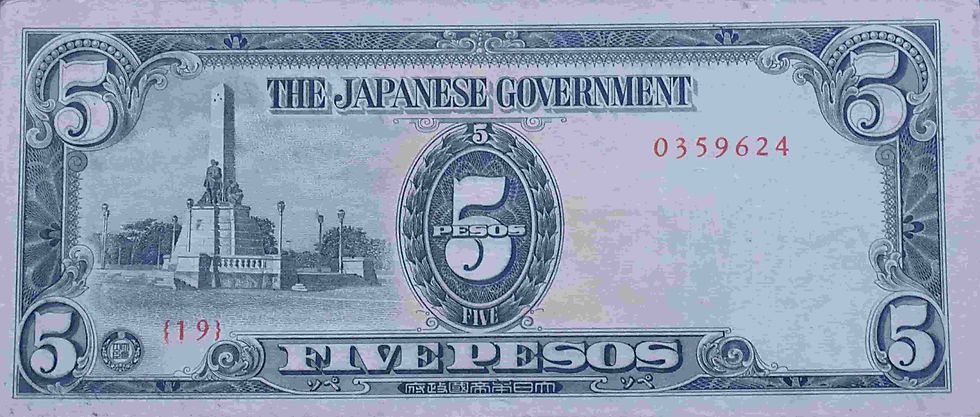
Obverse inscription: “The Japanese Government” appears prominently on the notes.
First-issue imagery: From 50 Centavos to 10 Pesos, earlier notes show two boys riding a carabao in an abaca field.
Later-issue imagery: The later issue replaced the earlier abaca scene with the Monument of José Rizal, except for the 1000 Peso note.
1000 Peso note: The 1000 Peso note used a different generic decorative design rather than a specific local landmark.
Serial Formats and Printing Diagnostics
First-Issue Block Letters
The first letter “P” indicated the Philippines.
The second letter ran from A to Z to track printing batches.
When the sequence reached “Z,” a third block letter was added to continue the series.
Fractional block letters were later introduced, with the letter “P” above and a two-letter block below.
Second-Issue Serial Format
The second issue introduced numerical serial numbers, while some denominations continued to retain the earlier block-letter system.

Counterfeits and Propaganda Notes
Counterfeit Blocks
50-centavo bills: PA, PB, PE, PF, PG, PH, PI
1-peso bills: PH
5-peso bills: PD
10-peso bills: PA, PB, PC
Propaganda Overprints
Some counterfeit notes were overprinted or labeled with messages such as “The Co-Prosperity Sphere: What is it worth?” These notes were used in psychological warfare and are especially collectible because of their wartime propaganda significance.


Occupation Medals
These medals were commissioned during the Japanese occupation to commemorate military victories in the Philippines.
Issued under General Masaharu Homma; inscription: “Commemorating the Expedition to the Philippines (1942).”
Issued under Katayama; inscription: “Commemorating the Expedition to the Philippines (1942).”
Quartermaster Corps Commemorative Medal 1942
Inscription: “Commemorating, Expedition to the Philippines (1942).”
Quartermaster Corps Commemorative Medal (Silver)
Inscribed: “Commemorating the conquest of the Philippines/December 27, 16th year of Showa (1941).”
Quartermaster Corps Commemorative Medal (Bronze)
Inscribed: “Commemorating the Great East Asia War/kaki 6561 unit (1941).”
Surrender of Bataan Medal (Bronze)
Private issue souvenir; inscription: “Commemorating the Surrender of Bataan (1942).”
Surrender of Bataan Medal (Silver)
Private issue souvenir; inscription: “Commemorating the Surrender of Bataan (1942).”
Authentication and Verification
For collectors and researchers interested in Japanese Invasion Money in the Philippines, the Numismatics.ph Japanese Invasion Money Catalog is presented in the source as a collector resource.
It provides a list of JIM issues specific to the Philippines.
It includes reference images for both genuine and counterfeit notes.
It includes details on Allied forgeries and tips for identifying them.
Collector Notes on Market & Rarity
Most surviving JIM notes remain relatively inexpensive because they were produced in massive quantities during World War II.
Condition affects value, with crisp Uncirculated notes bringing stronger prices than circulated examples.
Higher denominations such as 500 Pesos and 1000 Pesos are scarcer and often sell at a premium.
Certain block letter and serial number combinations are more sought after by collectors.
Notes with propaganda overprints are highly collectible.
Surviving Japanese occupation medals are extremely rare and highly sought after by collectors
References & Sources:
Basso, Aldo P. "Coins, Medals and Tokens of the Philippines." Menlo Park, CA: Chenby Publishers, 1968.
Selected numismatic articles, auction archives, and collector references used for comparative study.
Continue Your Philippine Numismatics Journey


Comments