The Manila Mint: A Turning Point in Philippine Monetary History

PHILIPPINE MONETARY MILESTONE
Home / Philippine Numismatics Collectors Hub / History & Insight / The Manila Mint

For centuries under Spanish rule, the Philippines did not have its own official mint. Coins used in everyday commerce were largely imported from other parts of the Spanish Empire, particularly from Spanish American mints such as Mexico. These foreign coins—especially the widely circulated silver peso and other milled coins—became the dominant currency in the archipelago. In some cases, these imported coins were later adapted for local use through counterstamping.
By the nineteenth century, however, the colonial monetary system faced growing instability. Changes in global bullion markets and the Philippines’ dependence on imported coinage—including lower-value copper coins—created recurring shortages of currency in circulation. These challenges eventually led Spain to establish a mint in Manila.
The creation of the Casa de Moneda de Manila, commonly known as the Manila Mint, marked a major turning point in Philippine monetary history. For the first time, coins intended specifically for the Philippines would be produced locally.
The Monetary Situation Before the Manila Mint
Before the establishment of the Manila Mint, the Philippines relied heavily on coins imported from Spanish American mints. Silver pesos from Mexico and other colonial mints circulated widely throughout the archipelago and served as the primary medium of exchange.
This system functioned effectively during the era of the Manila–Acapulco Galleon Trade, when large quantities of silver flowed from the Americas to Asia. Mexican pesos became a trusted international trade currency and circulated extensively in the Philippines and throughout Southeast Asia.
However, this arrangement also meant that the Philippine economy depended almost entirely on external sources of coinage. Without a local mint, the colony had little control over its own monetary supply.

Why Spain Did Not Establish a Mint Earlier
Although Spain ruled the Philippines beginning in the sixteenth century, a mint was not established in Manila until the nineteenth century. Several factors explain this long delay.
For much of the Spanish colonial period, the Philippines relied on a steady supply of silver coins from Spanish America rather than producing its own currency locally. The Manila–Acapulco Galleon Trade allowed large quantities of Mexican silver coins to reach Manila, where they circulated widely throughout the colony.
Another factor was the limited availability of precious metals suitable for large-scale coin production in the Philippines. While gold deposits existed in several regions of the archipelago, production was generally small-scale and inconsistent. Silver deposits were even more limited compared to the vast silver mines of Spanish America.
Spain already controlled some of the world’s richest silver-producing regions in Mexico and South America, where vast quantities of bullion were converted into coinage at established imperial mints. Because of this abundant supply, importing coins from the Americas was far more practical than building a new mint in the Philippines during the early centuries of Spanish rule.
This system began to change in the nineteenth century after Spain lost most of its American colonies in the early 1800s, disrupting traditional trade networks and reducing the steady flow of coinage to the Philippines. These developments eventually made the establishment of a local mint necessary.

Monetary Instability in the 19th Century
By the mid-1800s, several developments were affecting the stability of the Philippines’ monetary system.
One contributing factor was the global shift in precious-metal markets during the nineteenth century. Events such as the California Gold Rush beginning in 1848 increased the global supply of gold and disrupted traditional gold-silver ratios. These changes influenced the circulation and availability of silver coins in many regions of the world.
At the same time, the Philippines continued to rely heavily on imported silver pesos. Fluctuations in international bullion supply and trade therefore had a direct impact on the colony’s currency circulation.
These pressures highlighted the need for a more stable and locally controlled monetary system.

The Royal Decree Creating the Manila Mint
To address the growing currency challenges in the colony, Queen Isabella II issued a royal decree in 1857 ordering the establishment of a mint in Manila.
The new mint, officially named the Casa de Moneda de Manila, was intended to produce coins specifically for circulation in the Philippines under Spanish monetary standards.
Construction of the facility soon followed, and the mint was formally inaugurated on 19 March 1861. This marked the beginning of local coin production in the Philippines.

The First Coins of the Manila Mint
Gold Coinage
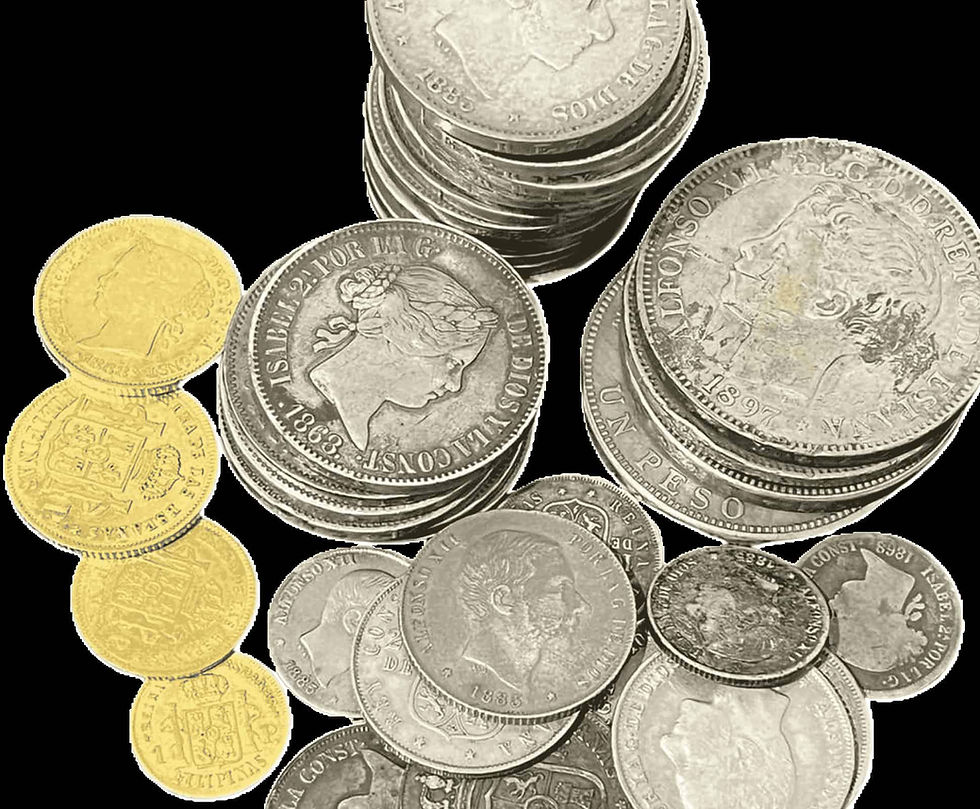
The first coins struck at the Manila Mint were gold coins issued in 1861. These coins were produced in three denominations:
1 Peso
2 Pesos
4 Pesos

They featured the portrait of Queen Isabella II and followed Spanish imperial coinage standards. These coins are historically significant because they were among the first coins minted in the Philippines specifically for circulation in the colony and prominently displayed the name FILIPINAS.
Silver Coinage
Soon after gold coin production began, the Spanish government authorized the minting of silver coins for everyday commerce.
Silver coinage began in 1864, introducing the following denominations:
10 Céntimos
20 Céntimos
50 Céntimos

Together with the gold coins, these issues formed a decimal monetary system:
1 Peso = 100 Céntimos
These coins circulated widely throughout the Philippines during the final decades of Spanish rule.
The Monarch Series of Spanish-Philippine Coinage
Coins produced at the Manila Mint reflected the reigning monarchs of Spain during the late nineteenth century.
Queen Isabella II (1861–1868)The earliest coins struck in Manila carried the portrait of Queen Isabella II and represent the beginning of locally minted Philippine coinage.

King Alfonso XII (1880–1885)After a period of limited mint activity, coinage resumed during the reign of Alfonso XII with updated designs.

For a detailed discussion of the denominations and designs produced at the Manila Mint, see the article Spanish-Philippine Decimal Coinage (1861–1898).
Closure of the Manila Mint
The Manila Mint continued operating intermittently during the late nineteenth century before being officially closed by royal order in 1889.
The closure was largely attributed to the mint’s limited productivity and the high cost of maintaining the facility compared with producing coins at larger mints in Spain.
Although there were later proposals in the 1890s to reopen the mint and produce additional coinage for the Philippines, these plans were never realized.

The Final Days and Destruction of the Mint
Although the mint ceased operations in the late nineteenth century, the building itself remained standing in Intramuros for several decades.
During the American colonial period, the structure was repurposed and, by 1920, was used for minting U.S.-Philippine coins.
The final chapter in the story of the Manila Mint building came during the Battle of Manila in 1945, when much of the historic district of Intramuros was devastated during World War II. Intense fighting destroyed many Spanish colonial structures.
The former Manila Mint building was among the structures that did not survive the battle, and the historic site where Philippine coinage first began was lost.

The Legacy of the Manila Mint
Although the Manila Mint operated for only a few decades, its impact on Philippine monetary history was profound.
The establishment of the Casa de Moneda de Manila in 1861 marked the first time that coins intended for circulation in the Philippines were produced locally. These coins helped stabilize the colony’s monetary system and introduced a standardized decimal coinage.
Today, the tradition of producing Philippine coinage continues through the facilities of the Bangko Sentral ng Pilipinas, particularly the Security Plant Complex, where circulating coins and commemorative issues for the Republic of the Philippines are manufactured.
In many ways, this modern minting facility represents the continuation of a tradition that began more than a century earlier with the establishment of the Manila Mint.
For collectors and historians, coins struck at the Manila Mint remain among the most historically significant artifacts of Philippine numismatics, representing the beginning of locally minted Philippine coinage.
References & Sources:
Ocampo, Ambeth R. "Yaman: History and Heritage in Philippine Money." Manila: Bangko Sentral ng Pilipinas, 2020.
Yap, Eldrich, and Janssen Bantugan. "Resellos Filipinos: Countermarked Coins of the Philippines." Quezon City, Philippines: Sact Sure Print Unlimited, 2018.
Scott, William Henry. "The Discovery of the Igorots: Spanish Contacts with the Pagans of Northern Luzon." Quezon City: New Day Publishers.
eNumismatic. “The Mint of Manila.”
Selected numismatic articles, auction archives, and collector references used for comparative study.
Continue Your Philippine Numismatics Journey


Comments